



Home
Types of pain we treat
Hand surgery


Hand surgery
Pain and restricted arm movement can significantly impact daily life, making both routine tasks and work activities difficult. Treatment involves a plastic surgeon, who performs the necessary operations, working alongside a pain specialist.

Guyon's canal
Guyon's canal syndrome is a type of entrapment neuropathy involving compression of the ulnar nerve at the wrist. It typically manifests as tingling, a "pins-and-needles" sensation, and numbness in the little finger and part of the ring finger, as well as hand weakness or impaired fine motor skills.
Symptoms most commonly arise from chronic overuse of the wrist, trauma, or an anatomical narrowing of Guyon's canal. Risk factors also include diabetes, thyroid disorders, rheumatoid arthritis, and the presence of a ganglion cyst in the wrist area. In advanced stages, weakness of the small muscles of the hand and finger deformity may occur.
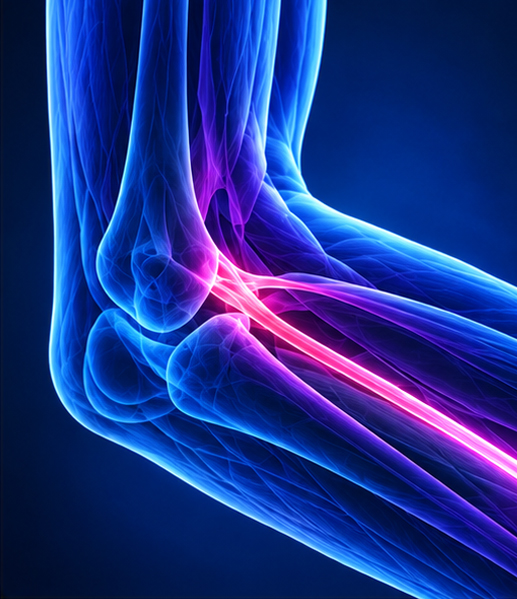
Cubital tunnel syndrome
Cubital tunnel syndrome occurs when the ulnar nerve is compressed at the elbow. Typical symptoms include tingling, numbness, and a loss of sensation in the little finger and part of the ring finger, often occurring particularly at night or when the elbow is bent for extended periods. Patients may also experience hand weakness, clumsiness during fine motor tasks, and a tendency to drop objects.
Symptoms often arise from repetitive strain on the elbow, the use of vibrating tools, sports activities, or injuries. In advanced stages, weakness of the hand muscles and restricted finger mobility may develop.
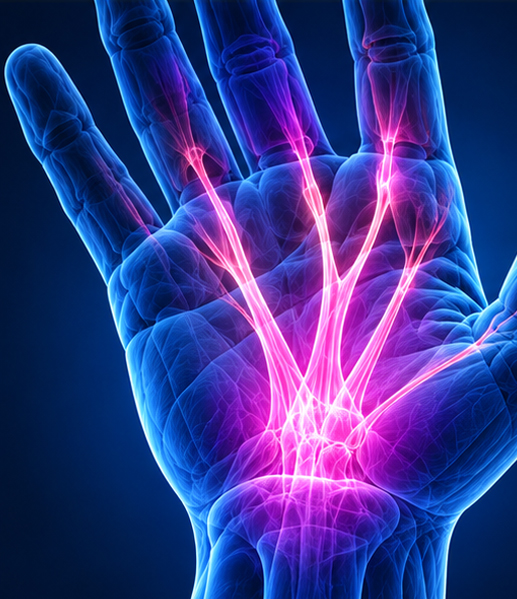
Dupuytren's contractures
Dupuytren's contracture is a hand condition characterized by the gradual thickening and shortening of the fibrous tissue in the palm. This results in the fingers progressively curling towards the palm and a restriction of their mobility. The ring finger and little finger are most commonly affected. The condition develops slowly over several years and is initially painless.
Typical symptoms include firm lumps or cords in the palm, an inability to fully straighten the fingers, and impaired hand function during everyday activities. In advanced stages, the deformity can significantly limit grip and the ability to handle objects.

Trigger finger
Trigger finger is a painful condition affecting the hand's tendons, characterized by the finger catching or locking during movement. It most commonly manifests as a painful snapping sensation or the finger locking in a bent position, making straightening it painful and restricted. A tender lump in the palm at the base of the affected finger is also a typical symptom.
The condition arises from a narrowing of the space through which the tendon passes, causing irritation and swelling. Risk factors include repetitive strain on the hand, diabetes, rheumatoid arthritis, or minor hand injuries. In the early stages, rest, splinting, rehabilitation, or corticosteroid injections may help. If symptoms persist, a minimally invasive surgical procedure is performed under local anesthesia to release the tendon and restore full finger function.

Simple syndactyly
Syndactyly is a congenital developmental anomaly characterized by the fusion of two or more fingers or toes. The connection may involve only skin and soft tissues, though in some cases, the bones or nails are also fused. It most commonly affects the fingers and is evident at birth.
Treatment is surgical and involves separating the fused digits to restore mobility and proper hand function. The surgery is planned on an individual basis, depending on the extent of the condition and the child's age. Early intervention helps prevent deformities and supports the natural development of the hand.
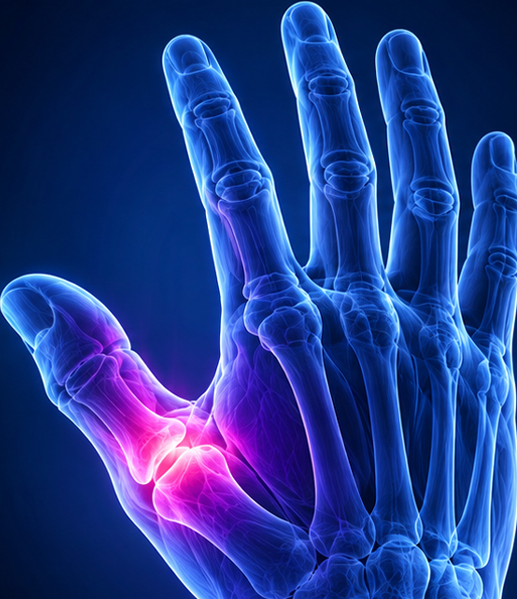
Polydactyly
Polydactyly is a congenital developmental anomaly characterized by the formation of one or more extra digits on the hand or foot. It can affect one or both limbs. It is most commonly a hereditary condition. Beyond aesthetic concerns, polydactyly can impair the proper function of the hand or foot and restrict movement.
Treatment is primarily surgical, involving the removal of the extra digit and the adjustment of surrounding structures to preserve the limb's function and appearance as much as possible. Surgery is most often performed during childhood and is typically followed by rehabilitation to promote mobility and the proper development of the hand or foot.
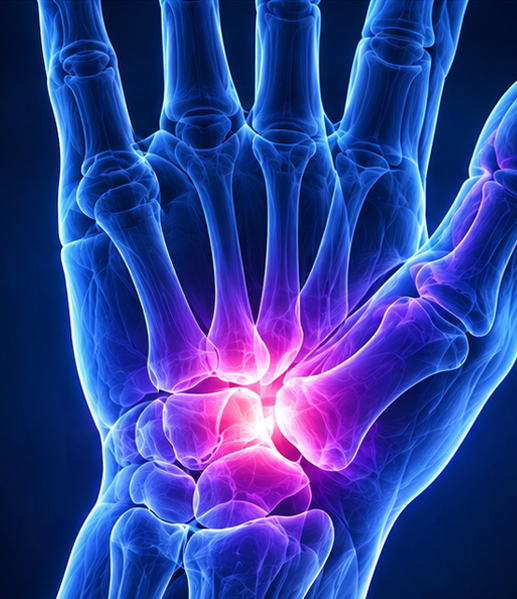
CMC joint replacement
Total CMC joint replacement offers a modern surgical solution for advanced rhizarthrosis—arthritis affecting the joint at the base of the thumb. The condition manifests as pain, reduced grip strength, and restricted thumb movement during everyday activities such as writing, opening bottles, or grasping objects.
The procedure is suitable for patients who have not found sufficient relief through conservative treatments—such as injections, bracing, or rehabilitation. During the surgery, the damaged joint is replaced with a modern endoprosthesis, which restores mobility, preserves the natural length of the thumb, and improves hand function.
Book a specialist consultation
Every patient and every pain condition requires an individual approach.
At the Pain Clinic, we employ modern diagnostic and treatment
methods aimed at precisely identifying the cause of the condition
and devising an appropriate treatment plan.
recepcia@painclinic.sk